AEO Is a Reputation System, Not a Metadata Project
Metadata can clarify a page. It cannot create the public evidence that makes a company claim believable, current, or safe to repeat.
A company adds organization schema, rewrites a title, creates an llms.txt file, and waits for the AI answer to improve.
The technical work may be correct. It is also much smaller than the reputation problem.
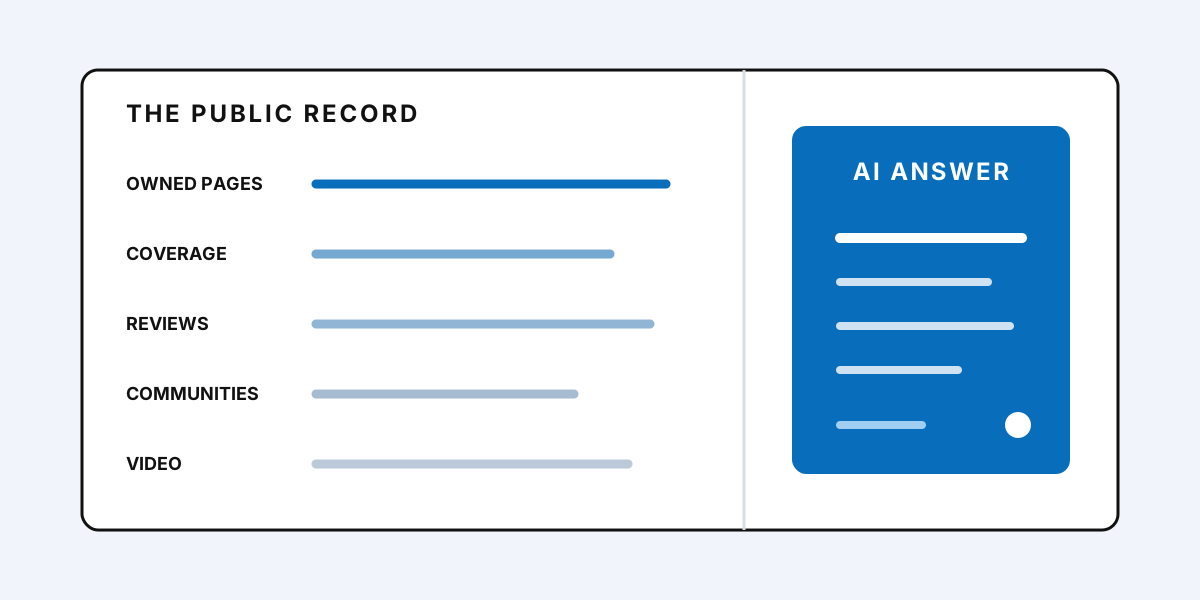
When an answer engine explains what a company does, compares it with alternatives, or recommends it for a buyer's situation, the answer can draw from a wider public record. The company website matters. So do independent articles, reviews, community discussions, public documentation, videos, and the evidence other people can find and verify.
Metadata describes the source. Reputation determines whether the claim has support beyond the source.
Metadata Can Clarify a Page, Not Create Belief
Titles, descriptions, structured data, canonical tags, crawl controls, and internal links help systems discover and interpret content. They are necessary parts of a healthy site.
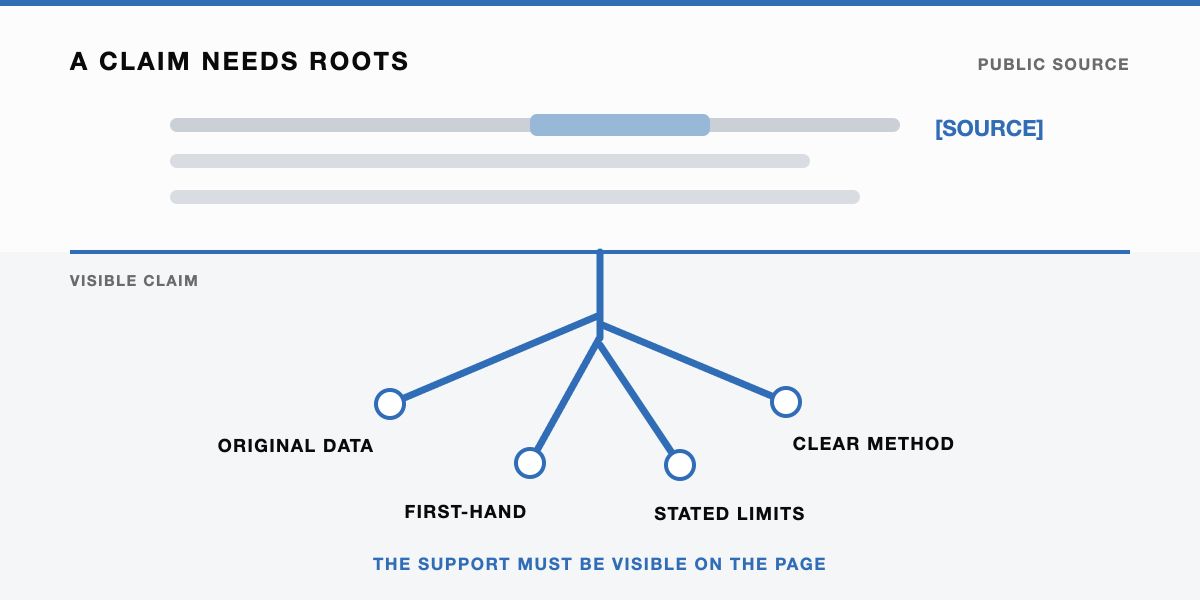
They cannot turn an unsupported statement into a supported one. Product markup does not prove the product works. Organization schema does not establish category leadership. A review snippet does not create customer trust when the underlying reviews are absent, vague, or contradictory.
Google's current guidance for AI features says there is no special schema required for AI Overviews or AI Mode. Existing SEO fundamentals still apply, and structured data should match the visible page. The message is plain: markup can support understanding, but there is no metadata shortcut around useful, reliable content.
The first AEO decision is whether the public record contains an answer worth understanding.
The AI Answer Sits Inside the Public Record
AI search products can retrieve and cite web sources while constructing an answer. The exact sources, models, and retrieval paths vary by product and question. No company controls the final mix.
Google says AI Mode and AI Overviews can issue related searches across subtopics and data sources, then show supporting links. OpenAI says public websites can appear in ChatGPT search when discoverable by OAI-SearchBot. Bing now reports publisher citations across Copilot, AI summaries, and supported partner experiences.
That does not mean every public mention will be used or that citation guarantees a favorable answer. It means the reputation surface extends beyond one optimized URL.
A company can make its owned source clear and accessible. It must also understand the outside sources that already define the category, customer experience, comparative position, and proof.
Reputation Is Claim by Claim
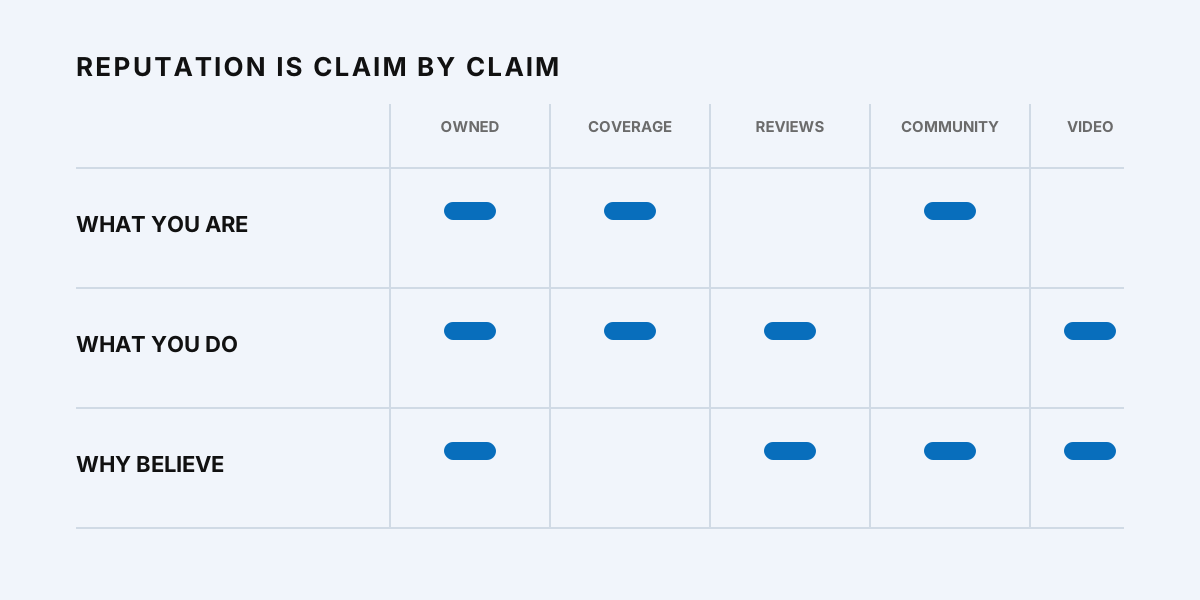
A brand does not have one universal AEO score. It has a set of claims that may be clear, supported, contested, stale, or missing.
What category does the company belong to? Which buyer problem does it solve? Which capabilities are real? Who is it for? What evidence supports the result? How does it compare with the alternatives?
Each claim can have a different evidence pattern. The company may define the category clearly on its own site while outside coverage still uses the old label. Reviews may support ease of use while community discussion exposes a limitation the product page ignores. A video demonstration may prove a workflow more clearly than a paragraph.
Owned Pages Establish the Canonical Company Truth
The company site should give answer engines a stable place to verify current facts. That includes positioning, product capabilities, customer fit, pricing method, policies, evidence, and the terms the business actually uses.
These pages should resolve ambiguity rather than distribute it. If the homepage, product pages, sales deck, help center, and executive interviews describe different categories or capabilities, the public record starts with a conflict.
Use clear source ownership and change history. Make important content available in text even when the best explanation also uses a diagram or video. Link related pages so the system can understand which source carries the full answer.
This is the foundation described in Give AI Search Something Worth Citing. The company needs a strong primary source before it asks outside sources to reinforce the claim.
Outside Evidence Adds Context the Company Cannot Self-Issue
Independent coverage, research, partner documentation, analyst material, event discussions, and credible comparisons can support a claim from outside the company domain.
The objective is not a pile of mentions. A generic announcement may add the company name without explaining why it matters. Useful outside evidence ties the company to a real category, decision, method, result, or point of view.
The company can improve the quality of that evidence by publishing source material people can inspect, making qualified experts available, sharing methods, and correcting facts without trying to control the writer's conclusion.
Manufactured consensus creates a fragile record. Repeated sponsored language, thin syndication, or undisclosed promotion may increase surface area while decreasing the amount of independent information a buyer can trust.
Reviews and Communities Show the Lived Product
Reviews and community discussions often answer questions company pages avoid. Buyers describe implementation, service, limitations, workarounds, and the difference between the promise and the experience.
That evidence can support the company or challenge it. Both are useful. A repeated complaint may reveal a product issue, a positioning mismatch, or an expectation the website created. Deleting the signal from a dashboard does not remove it from the public record.
The response should begin with the underlying truth. Fix the product or expectation where necessary. Give customers accurate information they can reference. Participate in communities with expertise and disclosure, not scripted praise.
A reputation system treats public disagreement as evidence to understand, not metadata to suppress.
Video and Other Formats Expand the Evidence Surface
Some claims are easier to verify through demonstration. A workflow video can show the actual sequence. An expert interview can expose the reasoning behind a method. A webinar can preserve questions the company did not anticipate on a product page.
Make the evidence accessible. Use stable watch pages, descriptive titles, transcripts, captions, and nearby text that states the subject clearly. Keep facts aligned across the video, transcript, page, and current product.
Google recommends supporting text with useful images and videos when appropriate, while keeping important content available in textual form. The point is not format multiplication. It is giving a real claim the format that makes it easiest to inspect.
Build a Public Evidence Audit
Start with the buyer questions the company should own. For each question, record the answer the business wants to be true, the owned source, the strongest outside evidence, any contradiction, and the person responsible for keeping the record current.
The Public Evidence Audit
Claim: What exact statement may affect a buyer's decision?
Owned source: Where does the company state the current answer?
Outside support: Which independent sources verify or explain it?
Contradiction: What public evidence points to a different answer?
Coverage gap: Which important claim has no useful public source?
Owner: Who must repair the truth when the answer changes?
This creates a work queue based on reputation gaps rather than schema opportunities. Some gaps require a better page. Others require research, customer proof, public expertise, product correction, or time.
Measure the Source Pattern, Not Just the Mention
A company mention can be neutral, wrong, poorly supported, or irrelevant to the buyer decision. Record the answer, claim accuracy, citations, source types, competitors present, and the role each source appears to play.
Look for repeated gaps. Does the company appear only when its own site is cited? Do outside sources support the old positioning? Are reviews carrying the answer for product experience while the company page remains vague? Does one third-party article control a comparison?
Bing's AI Performance reporting is useful because it separates citation activity by page and grounding query while warning that citation counts do not prove ranking or authority. That is the right level of caution. Citations are evidence about source use, not a complete reputation score.
The One-Sentence Version
AEO improves when the company's important claims are clear, consistent, and supported across the public sources an answer engine can inspect.
Sources
Frequently Asked Questions
Is Schema Markup Enough for AEO?
No. Structured data can help systems understand visible page content, but it cannot create missing expertise, independent support, customer evidence, or consistency across the public record.
What Public Evidence Can Influence AI Search Answers?
Relevant evidence can include company pages, independent coverage, reviews, discussion communities, research, public documentation, videos, transcripts, and other accessible sources tied to the question.
How Should a Company Build an AEO Reputation System?
Define the claims buyers need to verify, publish clear owned sources, earn accurate outside evidence, align facts across formats, monitor answers and citations, and repair the controlling sources when information is wrong.
How Should AEO Reputation Be Measured?
Track answer accuracy, claim coverage, cited pages, source diversity, repeated source gaps, and whether stronger public evidence changes qualified visibility over time.