AI Makes Content Cheap and Judgment Becomes the Bottleneck
AI can produce more competent content than a marketing team can meaningfully evaluate. The advantage no longer comes from making the most. It comes from knowing which ideas deserve the company's evidence, attention, and name.
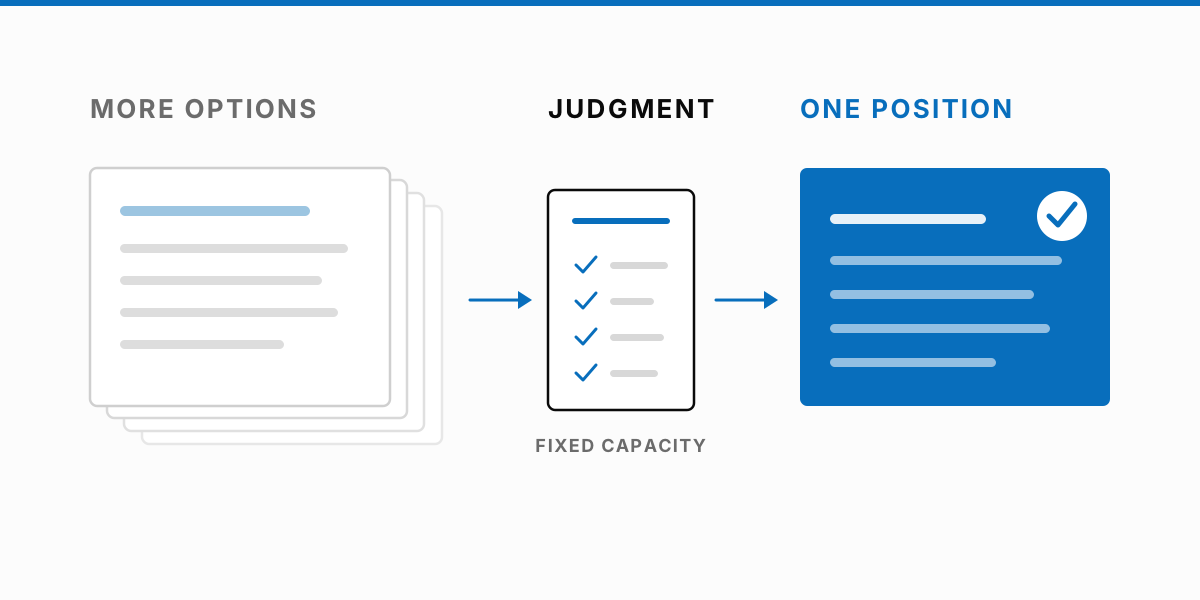
The expensive part of content has changed. Producing a competent first draft used to consume most of the schedule. Now a model can make more options before a team has decided why one should exist.
This is a real productivity gain. In a controlled experiment with 453 professionals completing writing tasks, Shakked Noy and Whitney Zhang found that access to ChatGPT reduced average completion time by 40 percent and raised evaluator-rated quality by 18 percent.
The mistake is treating that gain as a reason to fill every channel. Faster production creates value only when the company can recognize a worthwhile idea, support it, finish it, and decide where it should go. Without that judgment, the company converts saved production time into a larger pile of work to review.
The Bottleneck Did Not Disappear, It Moved
When production was scarce, good ideas waited for writers, designers, editors, and channel specialists. The operating question was whether the team could make enough.
AI changes the constraint. A team can explore several angles, structures, headlines, and formats quickly. Human attention does not expand at the same rate. Neither does the supply of people who understand the customer, know the evidence, recognize the brand, and have authority to commit.
This creates a judgment queue. Drafts wait for someone to decide whether the thesis is right, the claim is supportable, the expression is strong, and the work deserves distribution. If the company leaves the old review process in place, it may save time on drafting and spend the gain sorting through material that should never have reached production.
Harvard Business School's field experiment with 758 consultants showed the opportunity and the boundary. For tasks inside the model's capability frontier, AI users worked faster and produced higher-rated results. On a task outside that frontier, AI users were more likely to accept an incorrect answer. More capability creates more need to know where the capability ends.
Acceptable Is the Dangerous Category
Bad work is easy to kill. It is obviously false, clumsy, or broken. Acceptable work is harder. It sounds reasonable. It follows the brief. Nobody hates it. Nobody would miss it either.
AI is exceptionally good at producing this middle. That can raise the floor for a weak first draft. At scale, it can also surround the audience with competent sameness.
A Science Advances experiment on AI-assisted story writing found that access to generative AI ideas improved individual evaluations, especially for less creative writers, while making the resulting stories more similar to one another. The research studied short fiction, not marketing. The operating implication for marketing is still useful: a better average output does not guarantee a more distinct body of work.
A marketing team that publishes every acceptable draft spends four scarce resources: editorial review, distribution capacity, brand attention, and the audience's patience. The asset was cheap to make. The decision to place it in public was not.
Every asset is cheap until it asks the audience to spend attention on it.
Judgment Has Four Parts
Judgment is often reduced to taste, as if the final decision belongs to the person with the strongest aesthetic preference. Taste matters. It is only one part of the job.
Customer understanding chooses the question
The first judgment happens before writing. A team must know which customer problem is important enough to earn a piece of work. This requires more than a persona and a keyword. It requires current customer understanding, including what changed, which decision is difficult, and which explanation would help.
AI can develop a topic. It cannot make that topic consequential to a customer the company has not bothered to understand.
Evidence makes the claim defensible
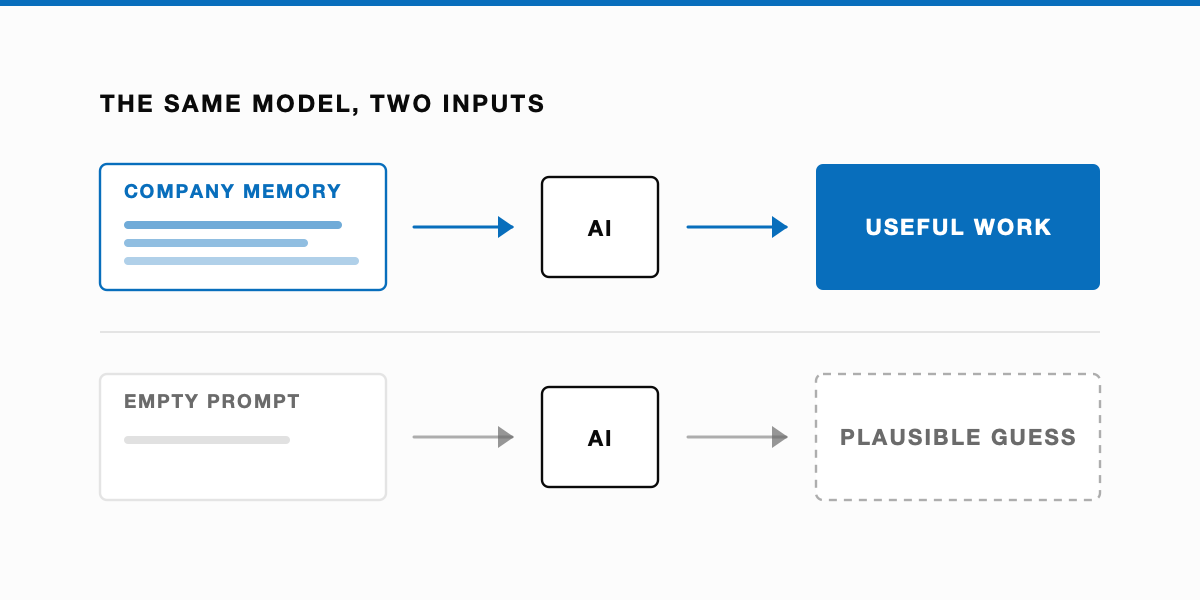
A sharp sentence does not become true because it survived several revisions. The company needs a source packet, verified product facts, and a clear line between observation and interpretation. This is why company context improves every content workflow.
Evidence also creates specificity. Real customer language, product behavior, experiments, and firsthand decisions give the work something a generic prompt cannot reproduce.
Taste makes the work recognizable
Taste is the ability to recognize the right proportion, voice, pacing, and finish for this company in this moment. It includes knowing what to remove. A brand voice document can describe patterns. It cannot make the final call when two accurate options are both defensible and one is clearly stronger.
Taste develops through exposure to excellent work, direct contact with the audience, and responsibility for the result. It cannot be outsourced to a list of adjectives.
Rejection turns options into a position
A company reveals its position through what it refuses to say and publish. If every plausible angle survives, the brand has no point of view. It has inventory.
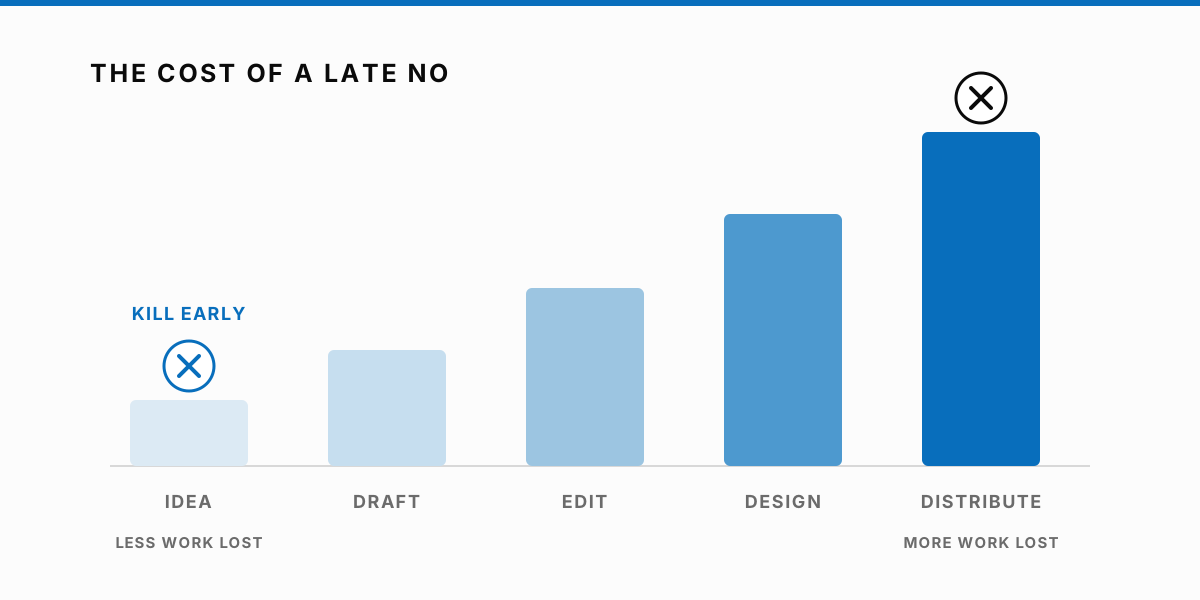
The ability to reject is not a brake on AI productivity. It is what converts abundant options into a coherent choice. A serious content system should make it easy to kill weak ideas early, before the team spends time finishing, approving, distributing, and measuring them.
Move Senior Attention Upstream
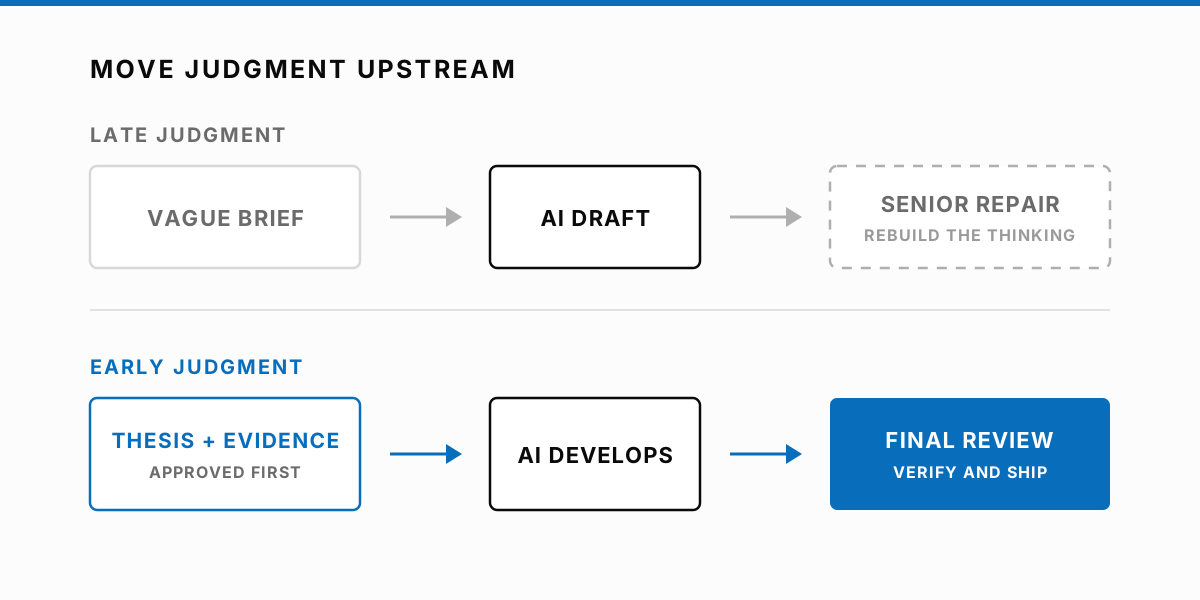
The expensive version of AI content begins with a vague request, generates a full draft, and then asks a senior person to repair the thinking. The model saved junior production time and created senior editing work.
Move the senior judgment before the draft. Decide the audience, the belief worth changing, the thesis, the source standard, and the reason this company should make the argument. Then use AI to explore structure, challenge the reasoning, surface counterarguments, and adapt the approved idea.
This is consistent with what knowledge workers report about AI-assisted work. A 2025 Microsoft Research study collected 936 examples from 319 professionals and found that critical work shifted from execution toward verification, response integration, and task stewardship. The study also found an association between higher confidence in AI and less reported critical thinking. It did not establish that AI caused weaker judgment, but it identified the operating pressure clearly.
The person accountable for the content still owns the result. AI can prepare more choices. It cannot absorb the consequence of choosing the wrong one.
Build a Rejection System, Not a Content Factory
A useful AI content workflow should spend the least effort on the weakest ideas. That requires gates before production becomes expensive.
- Name the decision. State what the intended reader should understand or do differently.
- Attach the evidence. Give the workflow the exact sources that make the argument possible.
- Write the kill criteria. Define what would make the idea too generic, weakly supported, irrelevant, or wrong for the brand.
- Limit full production. Explore alternatives, but finish only the options that survive the early decision.
- Give one editor the verdict. Input can be broad. Publication authority should be clear.
This changes the meaning of capacity. Production capacity becomes a reserve the team can use when an important idea appears. It is not a quota that must be filled because the tool can produce more.
The same principle belongs in the broader Creation system. One approved strategy can move faster through several formats. The team still needs to decide which work earns the right to carry it.
Measure the Judgment Load
Draft count, prompt count, and assets produced are weak measures of AI adoption. They describe activity at the cheapest part of the system.
Track where human attention goes. How many ideas die before a full draft? How much senior review does each published piece require? Which rejection reasons recur? Does the finished work get used by sales, cited by customers, or reused because the idea remains valuable?
There is no universal healthy rejection rate. A team that rejects nothing probably has no standard. A team that rejects everything after final production has a weak brief and an expensive review process. The goal is not rejection for its own sake. The goal is to move the no earlier while giving the strongest work more care.
This is also how leaders should judge AI adoption. The proof is not that people generated more material. It is that the team can own better work with less rescue while preserving the judgment required to know when the output is weak.
The One-Sentence Version
When production becomes abundant, the advantage belongs to the company that knows what to reject and what deserves its full attention.
Sources
- Noy and Zhang, Experimental evidence on the productivity effects of generative artificial intelligence
- Dell'Acqua et al., Navigating the Jagged Technological Frontier
- Doshi and Hauser, Generative AI enhances individual creativity but reduces the collective diversity of novel content
- Lee et al., The Impact of Generative AI on Critical Thinking
Frequently Asked Questions
What Does Judgment Mean in AI Content?
Judgment means choosing a real customer problem, demanding evidence, recognizing work that fits the brand, and rejecting output that does not deserve the audience's attention.
Should AI Increase a Marketing Team's Content Output?
It can, but output volume should follow a valuable decision and a distribution need. Production capacity is useful even when the company chooses not to use all of it.
What Work Should AI Own in Content Creation?
AI can organize sources, explore structures, develop counterarguments, draft alternatives, and adapt approved ideas. A human should own the thesis, evidence standard, brand judgment, and final publication decision.
How Can a Marketing Team Avoid Generic AI Content?
Begin with customer evidence, a declared point of view, and a decision worth changing. Define rejection criteria before generating options, then publish only work that is true, distinct, and useful.
The AI Tool Arsenal
Many new AI tools are just noise. I test them so you can use the best ones. Use it, watch it, skip it, with the reasoning.
Occasional, no more than weekly. Unsubscribe any time.