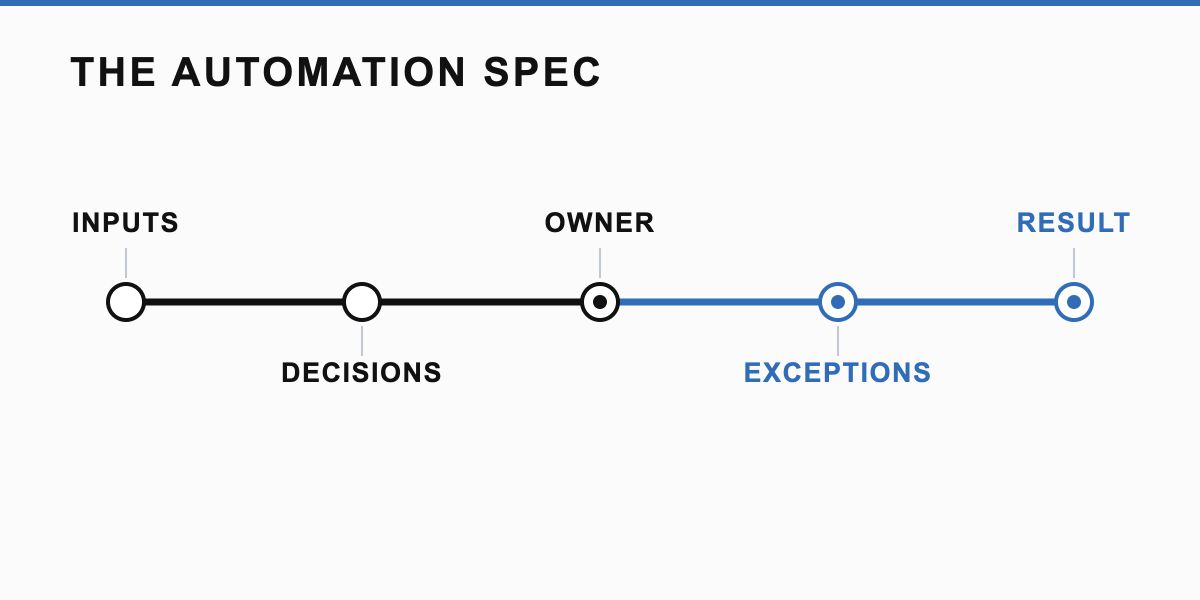
Most Companies Are Adding AI to a Broken Go-to-Market System
AI raises the throughput of whatever the go-to-market system already believes, owns, and measures. When that system is incoherent, the company gets faster at producing the wrong work.
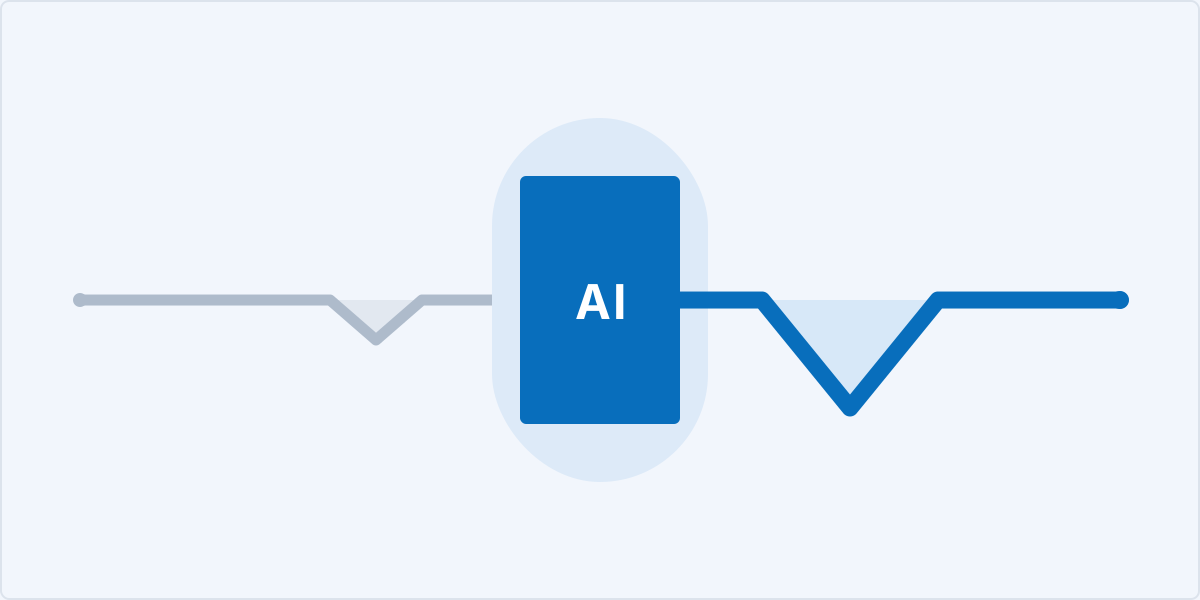
Most companies are doing the easy part first. They give the team an AI tool, connect a few systems, announce an efficiency target, and ask each function to find use cases.
The hard part remains untouched. Product describes one buyer. Marketing speaks to another. Sales rewrites the position on every call. Customer evidence lives in scattered recordings and memory. CRM fields carry several definitions. Cross-functional decisions have participants but no owner.
AI can work inside that system. It can summarize the calls, draft the campaigns, score the accounts, route the leads, and generate the next action. The output may be polished. The underlying contradiction remains.
AI does not repair the go-to-market system before it scales it. It multiplies the system it receives.
Faster Execution Can Hide a Worse Decision
A manual GTM system is slow enough for disagreement to surface. A campaign brief starts a debate. A sales leader rejects the lead definition. A product marketer corrects the claim. These interruptions are expensive, but they reveal that the company has not settled the logic.
AI reduces the visible friction. It can merge conflicting source material into one confident answer and produce a hundred assets from it. The company experiences less debate because the contradiction has been converted into fluent language.
This creates a dangerous form of progress. Cycle time falls while correction cost moves downstream. The sales team receives more accounts that do not fit. Customers see claims the product cannot support. Reporting becomes more precise around categories nobody agreed to use.
Current enterprise research points to the same operating issue. McKinsey's 2025 global survey found that workflow redesign had the strongest relationship with reported EBIT impact among 25 attributes it tested. Only 21 percent of respondents using generative AI said their organizations had fundamentally redesigned at least some workflows. The finding does not prove a formula for AI value, but it does reject the idea that adding a tool to the existing process is enough.
The Four Faults AI Makes More Expensive
A broken GTM system rarely looks broken from inside one department. Each team has a plausible local method. The failure appears where their definitions, evidence, and decisions meet.
Positioning
Weak Positioning Becomes High-Volume Inconsistency
If the company cannot state the category, buyer, problem, and reason to choose in one coherent position, AI will not settle it. It will generate a reasonable version for every request. Brand language, campaign claims, sales talk tracks, and product pages drift while sounding internally consistent.
Customer
Poor Understanding Becomes Synthetic Confidence
Personas and old research decks give a model a vocabulary, not current customer truth. When exact objections, buying conditions, failure reasons, and product evidence are missing, the system fills the gaps with patterns that sound familiar. The company can publish a complete point of view that no actual customer expressed.
Data
Dirty Data Becomes Automated Misclassification
A lead score cannot repair an undefined lifecycle stage. An agent cannot know which account is active when identity resolution is weak. A generated report cannot reconcile fields whose meaning changes by team. AI turns unclear definitions and stale records into decisions at machine speed.
Ownership
Unclear Ownership Becomes Invisible Decision Debt
Automation assigns tasks more easily than it assigns accountability. When nobody owns the position, stage definition, exception, or commercial result, the system keeps moving. The unresolved decision disappears inside a queue until a customer, missed number, or broken handoff forces it back into view.
A Coherent Output Can Hide an Incoherent Company
Fluency is especially dangerous in cross-functional work. A model can combine the approved brand document, an old sales deck, support tickets, and CRM notes into one answer without revealing that the sources disagree.
That is a context problem, but the fix is not a larger context window. The company must decide which source controls each claim, what evidence may change the position, and who resolves a conflict. The context contract gives AI current source truth. The GTM operating model determines who has authority to create that truth.
OpenAI's 2025 enterprise report identifies workflow standardization, data readiness, evaluations, system integration, executive sponsorship, and deliberate change management as common practices in its most advanced adopters. Those are operating capabilities. A better prompt cannot stand in for them.
Run the GTM Integrity Test Before Choosing Use Cases
Do not begin with a list of tasks AI could perform. Begin with the commercial decision the system must improve. Then test whether the company has enough shared truth and control to let the work run faster.
- Commercial truth
- Can product, marketing, and sales state the same buyer, problem, category, product promise, and reason to choose without reconciling their answers afterward?
- Customer evidence
- Are claims and priorities grounded in current, traceable customer and market evidence, with a named source controlling each important decision?
- Decision rights
- Does one person own each cross-functional decision, its exceptions, and the consequence when the result is wrong?
- Data definitions
- Do the critical stages, fields, account identities, and source labels mean one thing across the systems that will supply or receive AI work?
- Commercial result
- Can the owner name the business outcome, the baseline, the acceptance test, and the local metrics that must not be optimized at its expense?
A weak answer does not always block the work. It changes the scope. The team can use AI to gather evidence, expose differences, propose a definition, or prepare a decision. It should not automate the disputed choice as if the choice were already settled.
Fix the Source System Before the Prompt
The repair order matters. Start with the layer that gives every other layer meaning.
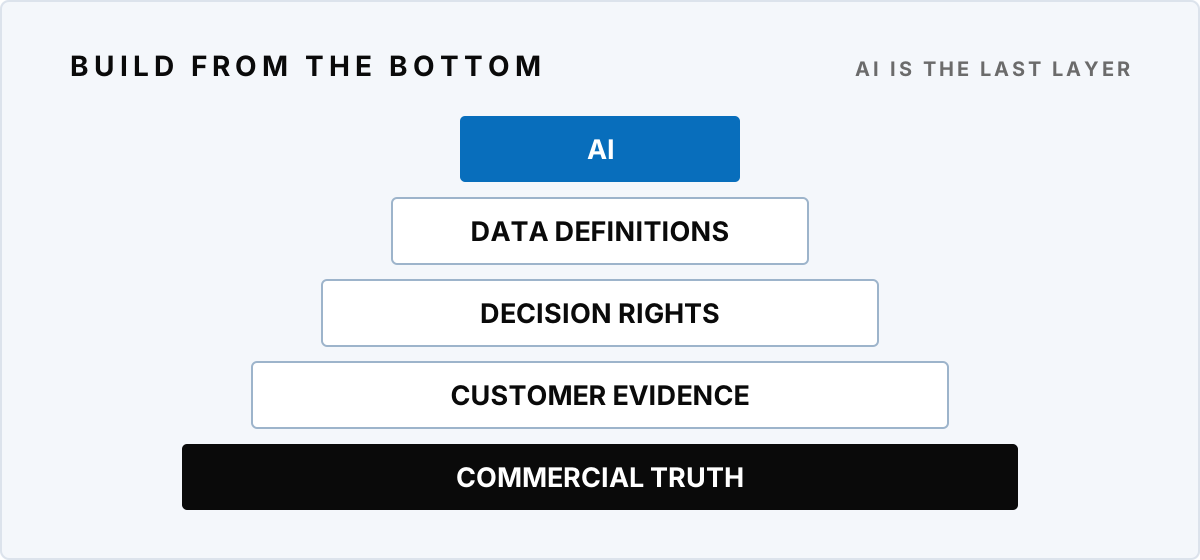
Commercial truth comes first. Settle the buyer, problem, category, product promise, and strategic tradeoffs. Positioning is a business decision, not a copy task. The positioning and category strategy must tell every downstream system what the company is trying to make true.
Customer evidence keeps that truth current. Build a continuous record of exact customer language, behavior, objections, buying conditions, and results. Research should change a decision or it should not be collected. The customer research system should preserve provenance instead of reducing evidence to a persona summary.
Decision rights prevent silent conflict. Name the owner, consulted experts, approval boundary, and exception resolver for each material cross-functional choice. Shared participation is useful. Shared accountability is usually an excuse to leave the decision open.
Data definitions make automation possible. Define the minimum fields the decision requires, who maintains them, how current they must be, and what the system does when they are missing. This is more useful than a general instruction to clean the CRM.
Sequence AI by Truth and Consequence
The first AI use case should not be the task with the most volume. It should be a task with stable truth, bounded authority, and a result that is easy to inspect.
Start with read-only or draft work that helps the team see the system: cluster customer evidence, compare current source definitions, flag missing fields, prepare account research, or summarize the reasons an exception occurred. These uses create speed without giving the model authority to hide an unresolved decision.
Move into actions only after the team can explain the process. The trigger, inputs, decision rule, owner, exception path, and accepted result must be visible. Write access and external delivery should follow demonstrated correctness, not enthusiasm.
McKinsey's 2026 research on organizational readiness reaches a similar conclusion from another angle. Companies moving further ahead focus on high-value areas, redesign the work around them, and treat AI as an organizational change effort. Spreading pilots across an unchanged company produces activity. It does not produce a new operating model.
Measure Fewer Corrections, Not More Outputs
AI adoption dashboards often measure active users, messages, assets, tasks, and time saved. These are useful operating signals. They do not show whether the GTM system makes better commercial decisions.
Track accepted results, correction time, exception reasons, source conflicts, handoff failures, and downstream reversals. Then connect them to the commercial outcome the workflow exists to change.
If output rises while corrections, overrides, and customer confusion also rise, the system is not scaling intelligence. It is scaling rework. A lower correction rate is often more valuable than a higher production rate because it proves the company is getting clearer before it gets faster.
The One-Sentence Version
Repair the GTM truth, evidence, decision rights, and data definitions before AI multiplies the faults.
Sources
Frequently Asked Questions
What Should a Company Fix Before Adding AI to Go-to-Market Work?
Align the commercial position, establish current customer evidence, assign decision rights, define critical data, and agree how the commercial result will be measured.
Can AI Repair a Broken Go-to-Market System?
AI can expose conflicts and help prepare decisions, but it cannot choose the company's position, settle ownership, or decide which source of customer and commercial truth should control the work.
Which Go-to-Market AI Use Cases Are Safest to Start With?
Start with bounded, reversible work that uses approved sources, has one accountable owner, and produces an output that a qualified reviewer can test before it reaches a customer or changes a system of record.
How Do You Know a Go-to-Market System Is Ready for AI?
The company can state what the system is trying to achieve, which evidence and fields it may trust, who owns each decision and exception, and how an accepted result will be recognized.