Five AI Agents Still Need One Accountable Owner
Agents can divide research, planning, creation, review, and delivery. They cannot divide responsibility for whether the final result was worth producing.
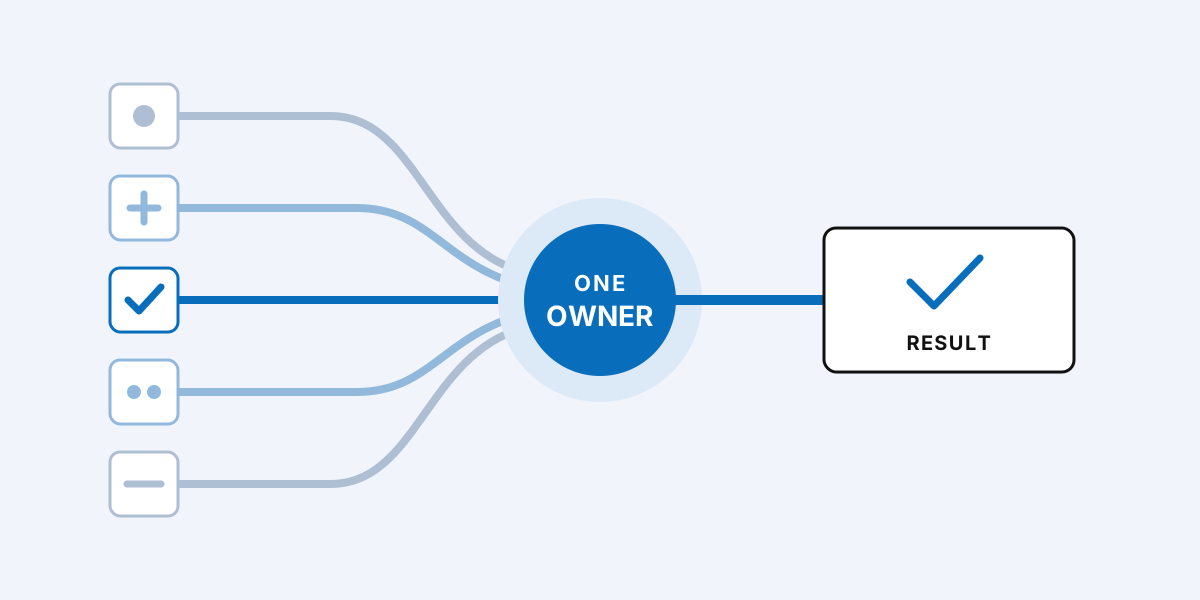
A company can assign one agent to research customer evidence, another to draft the plan, another to create the work, another to check it, and another to route the result. Every agent can finish its task. The campaign can still be wrong.
The customer problem may be real but commercially unimportant. The plan may follow the evidence but conflict with positioning. The draft may pass every content check and still make a promise the company should not make. The delivery agent may execute perfectly at the wrong time.
Specialization improves execution. It does not answer the business question: should this result exist, and is the company prepared to stand behind it?
Agents can own tasks. One person must own the consequence.
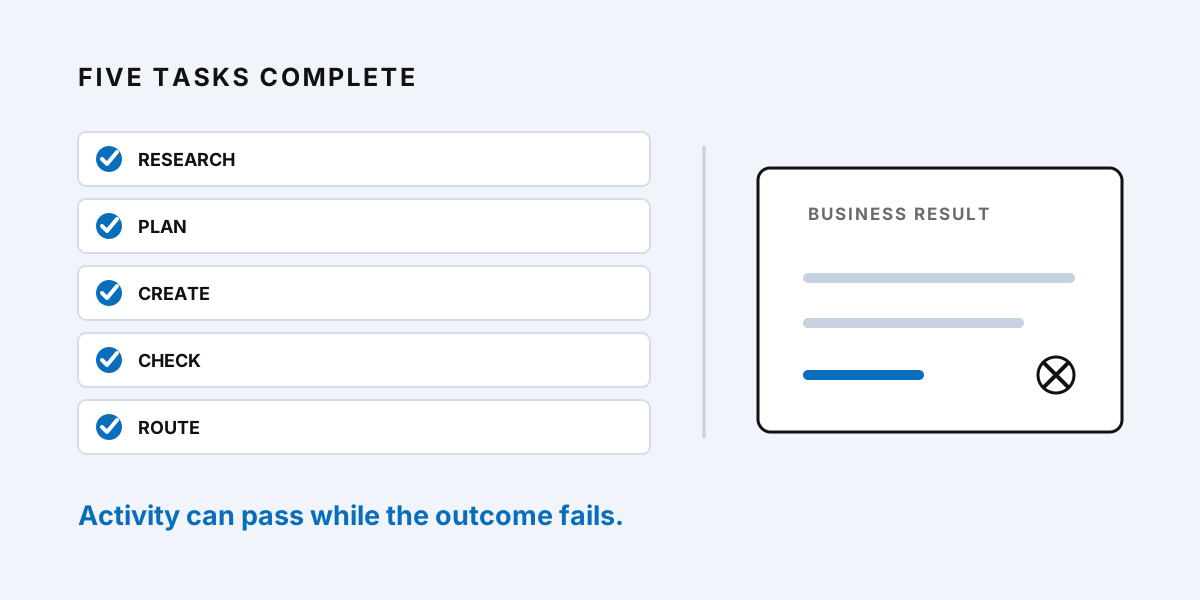
Five Completed Tasks Can Produce One Failed Result
Multi-agent systems make work easier to divide. That is useful when the job contains distinct disciplines or can benefit from parallel effort. It also creates a new way for accountability to disappear.
Each agent sees a local goal. The research agent finds relevant evidence. The planning agent produces a complete brief. The creation agent follows the brief. The review agent checks declared standards. The routing agent sends the approved artifact to its destination.
None of those local goals proves that the combined result advanced the commercial objective. A system can accumulate five successful task records around one bad decision.
Multi-Agent Architecture Is Not an Org Chart
A manager agent may coordinate specialists. Agents may also hand work directly to one another. These are orchestration patterns, not assignments of business authority.
A model can select the next task, call a tool, compare outputs, or stop when a declared condition is met. It cannot decide which customer promise the company is willing to make unless a human owner has already defined that policy. It cannot settle a conflict between short-term pipeline and long-term trust unless the business has supplied the rule or retained the decision.
Calling one agent the manager does not make it accountable. It only gives that agent a coordination role inside the system.
Name the Owner Before Naming the Agents
The accountable owner should be the person who already owns the business result the system exists to change. For a demand program, that may be the growth leader. For product positioning, it may be the CMO or product marketing leader. For a customer communication, it may be the leader who owns that customer promise.
The title matters less than the authority. The owner must be able to define the objective, resolve tradeoffs, change the policy, and stop the system when the operating cost or consequence no longer makes sense.
The Owner Contract
Outcome: What business result is this system expected to change?
Authority: Which actions may agents take without another decision?
Acceptance: What evidence proves the final result is fit to use?
Exceptions: Which conflicts, failures, or consequences return to the owner?
Operating decision: Who may expand, narrow, pause, or retire the system?
If nobody can answer those questions, adding agents will distribute the ambiguity. The system will have more workers and no real owner.
Give Every Agent a Bounded Contract
One accountable owner does not mean every agent receives the same vague objective. Each agent still needs a narrow contract: required input, permitted sources, specific output, tools, completion test, and stop conditions.
The research agent may collect current customer language without deciding the positioning. The planning agent may organize approved evidence without inventing claims. The creation agent may draft inside the brief without receiving publication authority. The review agent may identify unsupported statements without silently rewriting the strategy.
These boundaries make delegation useful. They also make failure diagnosable. When the final result misses, the owner can see whether the source truth, local contract, handoff, acceptance test, or business decision failed.
This builds on the earlier rule to explain the process before automating it. A multi-agent system needs that operating logic at every boundary, plus one owner who sees the complete result.
The Owner Should Review Exceptions, Not Every Step
Accountability is often confused with manual approval. If the owner must inspect every tool call and rewrite every output, the company has built an expensive interface around the same manual job.
Routine work should pass through declared acceptance tests. Required sources can be checked. Claims can be compared with approved evidence. Fields, links, permissions, and delivery states can be validated. Representative cases can test whether changes improve the system across more than one clean example.
The owner enters when the system reaches a real decision boundary: conflicting evidence, a new customer promise, an action with difficult consequences, a repeated failure, or a request outside policy.
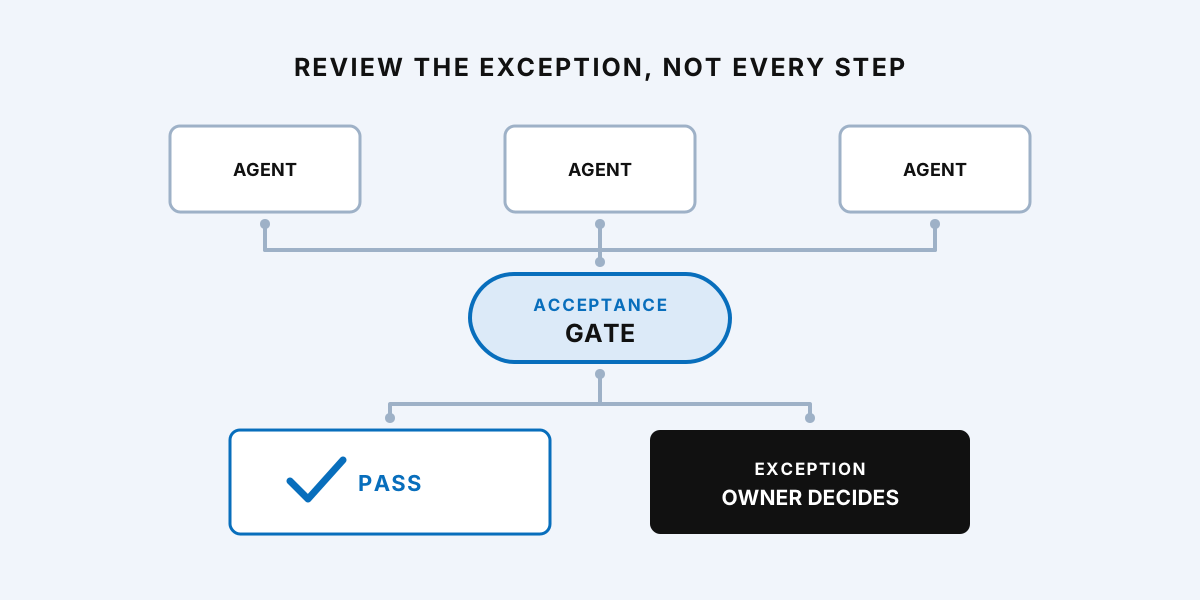
OpenAI's agent guidance recommends human intervention when failure thresholds are exceeded or an action is sensitive, irreversible, or high stakes. Its Agents SDK supports approval points that can pause a run even when the request comes from a nested agent. The technical control is useful because the business has declared which consequence deserves the owner's decision.
Make Handoffs Accountable to Evidence
Agents often lose more than data at a handoff. They lose the reason a decision was made.
Every handoff should preserve the source used, version, assumptions, output, acceptance status, and unresolved exception. The receiving agent should know what it may reopen and what has already been decided by the owner.
This prevents a planning agent from treating a research hypothesis as a company fact. It prevents a creation agent from turning an open question into polished certainty. It prevents a delivery agent from mistaking a completed draft for a released message.
The marketing engineer can design the contracts, context, tools, evaluations, and run record. The business owner still decides which result and consequence the system is allowed to produce.
Measure the Result, Not the Agent Activity
Agent dashboards make it easy to count runs, handoffs, tool calls, generated assets, and completed tasks. Those measures help diagnose the system. They do not prove value.
Measure accepted results, correction time, exception rate by reason, repeated failures, total human review, operating cost, and the commercial outcome the system exists to change. Then inspect local agent metrics only when they help explain movement in the final result.
A research agent that finds more evidence may increase latency without improving decisions. A review agent that flags more issues may be useful, or it may be applying a weak standard. A routing agent that processes twice the volume may simply publish more work nobody needed.
The owner closes that measurement loop. They decide whether the combined system is changing the right outcome at an acceptable cost.
Add Agents Only When Coordination Pays
More agents are not a maturity model. Each additional role adds another contract, context boundary, handoff, evaluation surface, failure path, and maintenance obligation.
OpenAI recommends expanding a single agent with tools before introducing multi-agent orchestration unless complex logic or tool overlap makes separation necessary. Anthropic gives the broader rule: begin with the simplest useful system and add multi-step agentic patterns only when evaluation shows the simpler approach falls short.
Add another agent when specialization or parallel work improves the accepted result enough to pay for the coordination. Do not add one because a diagram with five boxes looks more advanced.
The One-Sentence Version
Divide execution across as many agents as the work requires, but keep one human owner accountable for the final business result.
Sources
Frequently Asked Questions
Can Multiple AI Agents Share Accountability?
Multiple agents can share execution, but one human business owner should remain accountable for the final result, operating policy, and consequences.
What Does the Accountable Owner of an AI Agent System Do?
The owner defines the business outcome, permitted authority, acceptance standard, exception policy, and conditions for changing, scaling, or stopping the system.
Does the Owner Need to Review Every Agent Action?
No. Routine work can pass through declared tests. The owner should review consequential exceptions, policy conflicts, and changes to the system's authority.
When Should a Company Use Multiple AI Agents?
Use multiple agents when distinct specialization or parallel work improves the accepted result enough to justify added coordination, evaluation, latency, and maintenance.