The Marketing Engineer Is Not a Better Prompt Writer
A prompt can produce an answer. A marketing engineer builds the context, decisions, workflows, agents, evaluations, and measurement that make useful answers repeatable.

The easiest way to misunderstand the marketing engineer is to define the role by the interface they happen to use today.
Someone writes a strong prompt, connects an automation, or builds a small agent. The output looks technical, so the company assumes it has found the new role. It has usually found a capable AI user.
A marketing engineer owns a different problem: how to turn expert marketing judgment into a system another person or agent can run, inspect, improve, and reuse.
The durable asset is not the prompt. It is the operating logic around the prompt.
A Prompt Ends at the Response
A prompt can contain a detailed instruction and still leave the important decisions unresolved. Which source controls the claim? What customer evidence is current? Which fields are required? What action may the model take? Who approves an exception? How will the team know the result is better?
When one experienced operator supplies those answers from memory, the prompt may work. When the work moves to another person, another model, or a recurring workflow, the hidden judgment disappears.
This is why prompt collections decay so quickly. They preserve wording without preserving the business system that made the wording useful. The company accumulates clever instructions that depend on unstated context, local tool settings, one person's taste, and manual correction.
The marketing engineer moves those dependencies out of memory and into inspectable operating artifacts.
The Role Begins With Marketing Judgment
Marketing engineering is not a technical layer applied after the strategy is finished. The role must understand the decision well enough to model it.
That means knowing the difference between a customer signal and a segment conclusion, a campaign metric and a commercial result, a message variation and a positioning change, or an execution rule and a strategic tradeoff. Without that judgment, the system can be technically sound and commercially wrong.
The role should challenge weak operating logic before implementing it. If the buyer is unclear, the source truth conflicts, or ownership is missing, the work is not ready for automation. The broken GTM system becomes the first engineering problem.
The Unit of Work Is a Reusable System
A one-off AI answer may save time. A reusable system changes how the function operates. The distinction is whether the result improves the next run without requiring the original builder to reconstruct the method.
The marketing engineer creates six durable artifacts.
Decision standard
The Business Rule
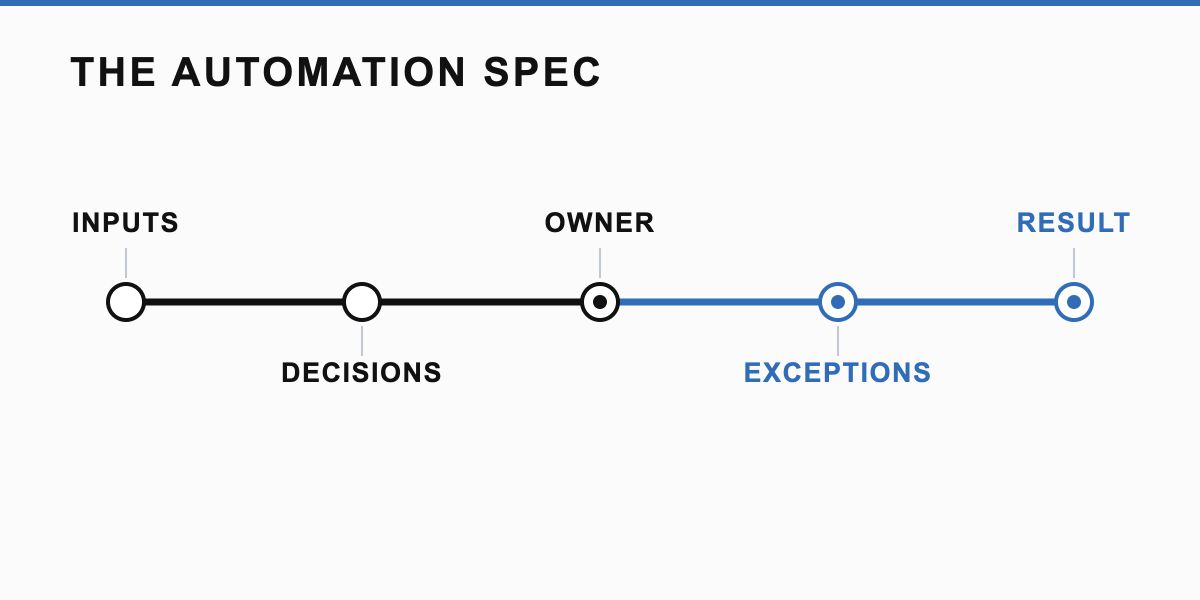
Define the decision, evidence required, permitted discretion, owner, exception path, and accepted result. The system needs a declared job before it needs a model.
Context architecture
The Sources and Data Model
Identify source truth, required fields, provenance, freshness, relationships, and conflict rules. Organize context so an operator or agent can find what the decision requires without receiving an uncontrolled data dump.
Execution design
The Workflow and Authority
Choose fixed logic, bounded model judgment, or an agent according to the variability of the work. Define tools, permissions, checkpoints, retries, stops, and the route back from an exception.
Quality system
The Evaluation Set
Turn expected behavior into representative cases, success criteria, graders, traces, and review. Include ordinary work, ambiguity, missing inputs, conflicting evidence, and known failure modes.
Commercial control
The Measurement Layer
Connect system performance to the marketing result. Track accepted outcomes, correction time, exception reasons, cost per completed job, and downstream movement instead of stopping at output volume.
Compounding asset
The Reusable Infrastructure
Package schemas, components, connectors, tools, tests, logs, documentation, and operating records so future workflows inherit proven decisions instead of starting from an empty chat.
The Role Sits at Four Interfaces
A marketing engineer should not become a translation queue between marketers and technical teams. The value comes from being able to work across four disciplines without losing the commercial decision.
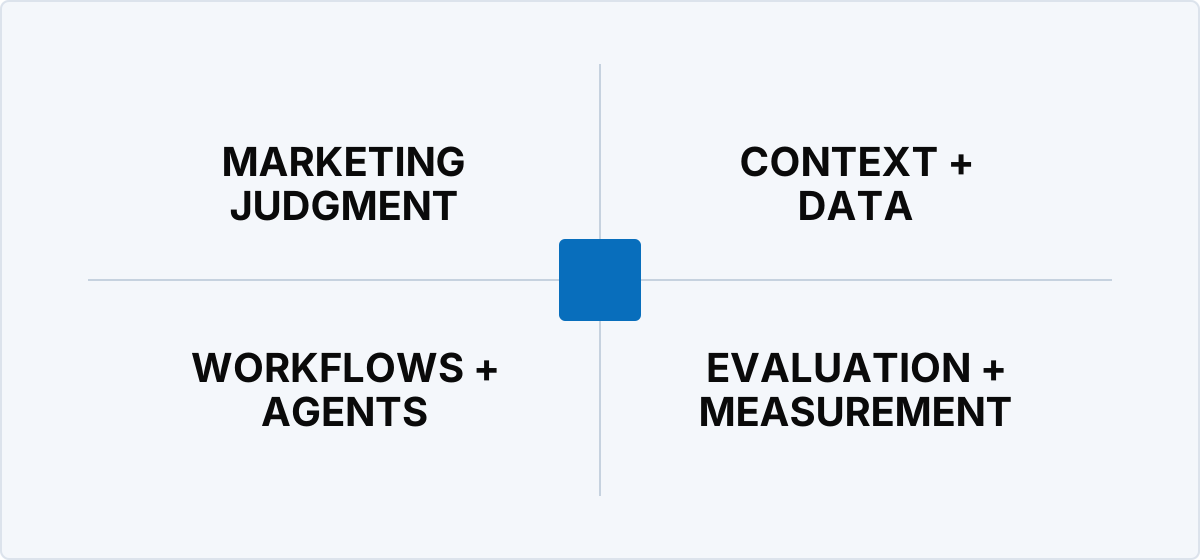
Marketing judgment defines what should happen and why. Context and data make the relevant evidence available in a form the system can use. Workflows and agents perform bounded work. Evaluation and measurement show whether the system behaved correctly and changed the intended result.
The role may sit in marketing operations, growth, an AI transformation team, or directly under the CMO. Reporting lines matter less than access to decisions, data, technical partners, and the business owner. A marketing engineer without authority to resolve operating ambiguity becomes an automation support desk.
Agents Increase the Need for Engineering
More capable models do not make the surrounding system less important. They make the environment, interfaces, and feedback loops more consequential because the model can do more with whatever it receives.
OpenAI's account of building an agent-first software product describes the human engineering job as designing environments, specifying intent, and building feedback loops that let agents do reliable work. The publication concerns software engineering, but the operating lesson transfers: prompt quality is one part of a larger harness.
Anthropic makes the same point from another direction. In its work on an agent for a software benchmark, the team reports spending more time improving tools than improving the overall prompt. Its guidance recommends simple system designs, clear tool interfaces, and added complexity only when evaluation shows a better outcome.
For marketing, the harness includes approved context, customer and product data, brand constraints, workflow state, tools, action permissions, logs, evaluations, and the commercial measure. The context contract is one component. The full job is to make the entire environment legible and testable.
Evaluation Is Part of the Build
Manual review can carry an early prototype. It cannot tell the company whether a change improved the system across the range of work it performs.
Anthropic defines an agent evaluation around tasks, trials, graders, and traces. That structure matters in marketing because the same workflow can encounter different evidence and produce different paths. A useful evaluation set includes the cases that decide whether the system deserves more authority.
The marketing engineer works with subject experts to turn taste and judgment into testable standards. Some checks can be deterministic: required fields, source presence, approved claims, valid links, or successful system updates. Others need human or model grading against a clear rubric. The evaluation should preserve the trace so a failed result can be explained, not merely scored.
Hire for System Judgment, Not a Tool Demo
A prompt challenge rewards familiarity with one model and one interface. It says little about whether the candidate can build a dependable marketing system.
Use a real workflow as the interview
Give the candidate an ambiguous but material marketing job. Ask them to identify the business decision, required evidence, source conflicts, workflow boundary, ownership, permitted actions, evaluation cases, measurement, and maintenance burden.
Then ask for the smallest useful implementation. The strongest candidate will remove ambiguity before adding complexity and will explain what the system should never decide.
Review the artifacts, not the performance. A strong marketing engineer leaves behind a clearer decision, an inspectable design, a working test, and a system the team can maintain. Tool choice is part of the answer, not the answer itself.
Measure Whether the Infrastructure Compounds
The role should not be judged by automations launched, prompts written, agents created, or vendor features adopted. Those measures encourage tool activity.
Measure time from a valid request to an accepted result, correction rate, repeated exceptions, human review time, data failures, system reuse, cost per accepted job, and the marketing outcome the workflow exists to change.
Then measure compounding. Does a new workflow reuse existing context, interfaces, evaluations, and components? Does a correction improve the next run? Can another qualified operator understand why the system behaved as it did? The role is succeeding when each build lowers the cost and uncertainty of the next one.
The One-Sentence Version
A marketing engineer makes expert marketing judgment executable, testable, measurable, and reusable.
Sources
Frequently Asked Questions
What Does a Marketing Engineer Do?
A marketing engineer turns marketing judgment into reusable operating systems by defining decisions, structuring context and data, designing workflows and agents, building evaluations, connecting measurement, and maintaining the infrastructure.
Does a Marketing Engineer Need to Be a Software Engineer?
Not necessarily, but the role needs enough technical fluency to work with data structures, APIs, workflow logic, agent tools, tests, logs, and code-assisted implementation without treating them as a black box.
How Is a Marketing Engineer Different From Marketing Operations?
Marketing operations often owns platforms, processes, data hygiene, and execution support. A marketing engineer focuses on making marketing decisions executable and reusable across systems. The roles can overlap, especially on lean teams.
How Should a Company Evaluate a Marketing Engineer Candidate?
Give the candidate a real marketing workflow with incomplete context and ask them to define the decision, required data, system boundary, authority, evaluation method, measurement, and maintenance plan before they build anything.